 |
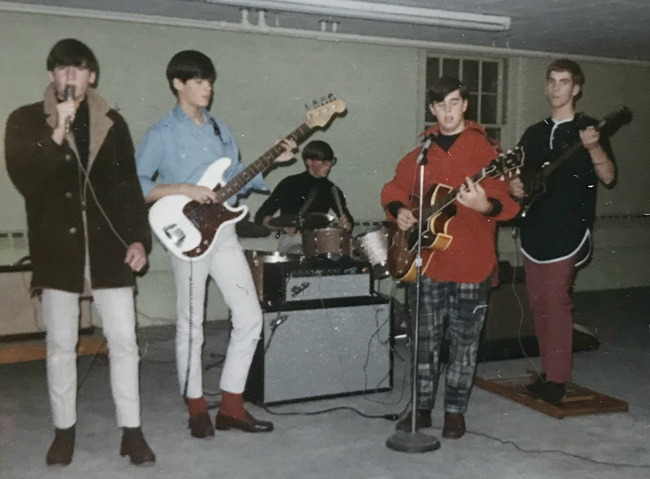
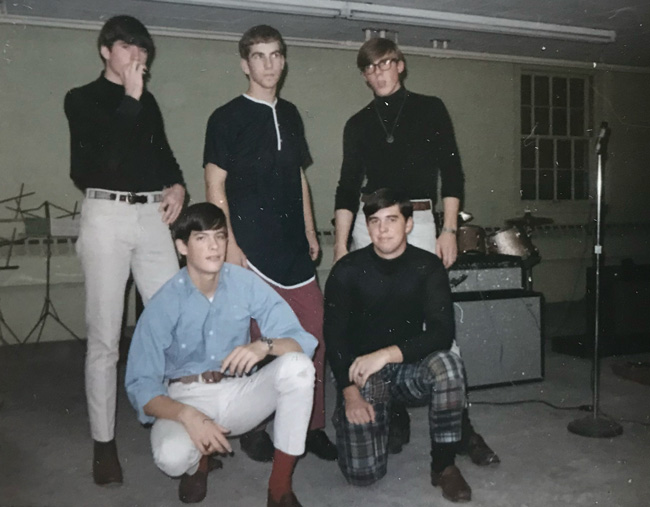
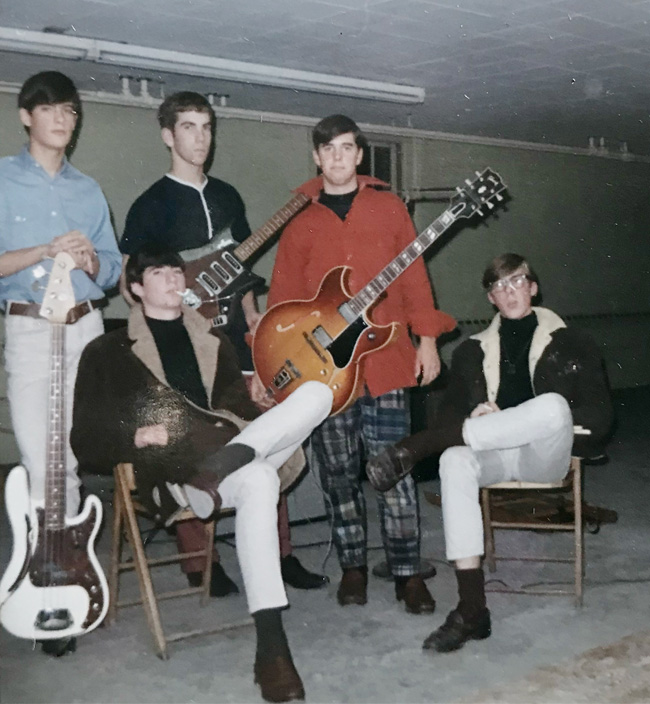
| Room 107 is where it’s at! From left: Don Carpenter, Joe Skladzien, Lee Bruder, Dennis Sullivan, Steve Jones. All photos and memorabilia courtesy of Lee Bruder. |
Something’s Going Right — The Gnomes: FOUND!
By Mike Markesich
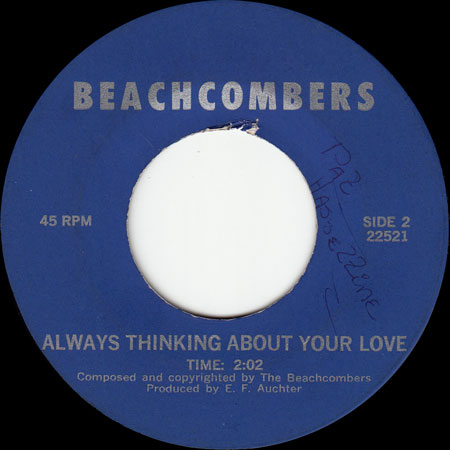
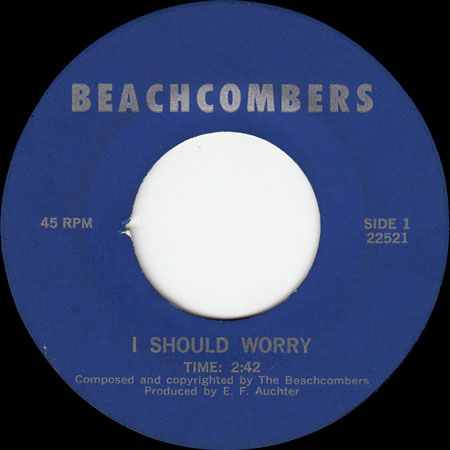
November 20, 2025. ’Twas the day Nightrocker and I made the trek from our southern parts of New England, on our way up north to the mountains of New Hampshire. This was no aimless Saturday road trip to gawk at the vibrant fall foliage on display. Leaves? Ha! This was BIG! We were on our way to meet the former drummer of thee most elusive and difficult 1960s teenaged rock & roll group to ever locate. The Gnomes.
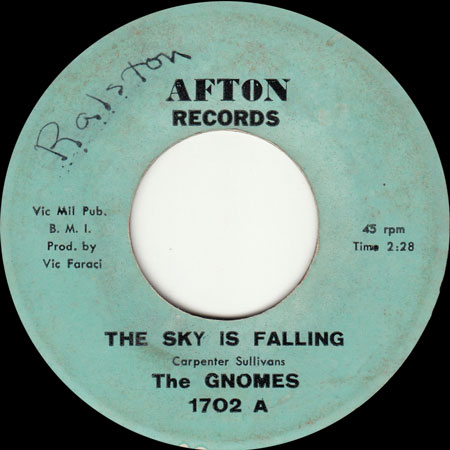
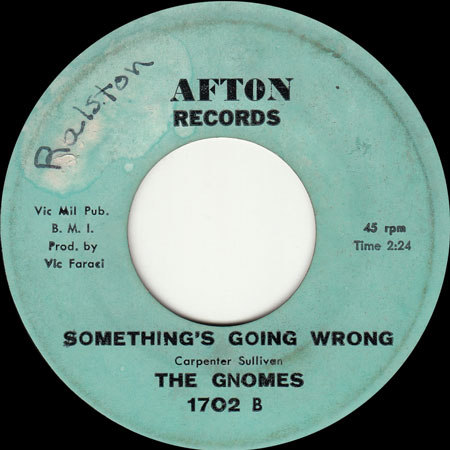
Hell, FORTY plus years of trying! Decades spent making random phone calls…mailing out letters…perusing old newspaper microfilms…Every single blind and potential lead — stonewalled. My first research trip to Washington, D.C., for harvesting song copyrights at the Library Of Congress in 1995 turned up nothing for the Gnomes. Such aforementioned efforts were attempted over the years not only by me, but by others mesmerized with their 45rpm disc. The only hard evidence to be had back then: Carpenter and Sullivan, two surnames printed on the record labels. Yeah, right. A needle in a haystack.
Well, sometimes, idioms be damned. Months earlier, a series of unexpected random events finally led us to paydirt. Nightrocker had saved a Gnomes 45 autographed label scan he found on-line. The inscription to a nameless recipient referenced leaving Lawrence and not graduating plus “…now you’ll get laid.” It was signed by “Carp.” We discovered another copy had sold privately, autographed by one Chris Ziagos. We knew that Ziagos must be related to the deceased former manager of of the What Four from Tufts University. Those guys waxed the well-known killer garage 45, “Basement Walls,” in early 1967. Was there a Gnomes connection somehow?
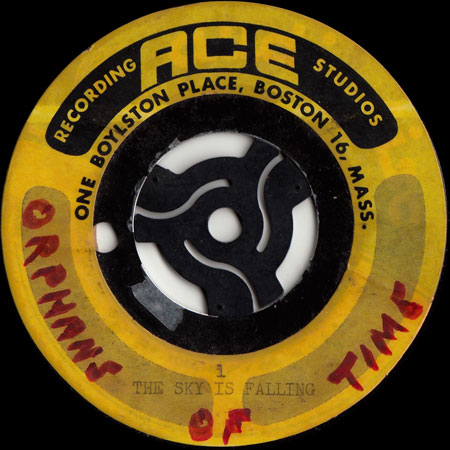
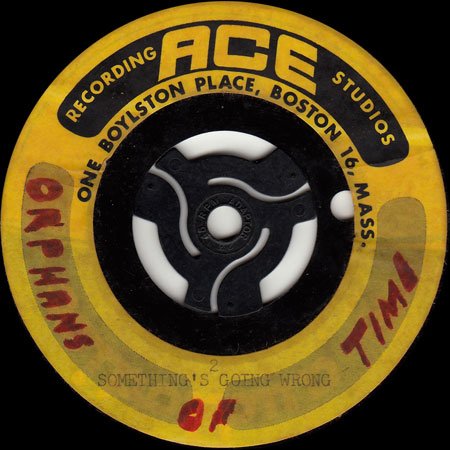
Newfound details of this vital evidence prompted my recollection from longtime expert record collector and fellow sleuth NW Buckeye (of Buckeyebeat.com). Long ago, he mentioned finding an Ace Recording Studio labeled acetate of both Gnomes songs, but no writing or info on it. Said studio was located in downtown Boston. OK then, location surely pinpoints New England territory. A high school in Lawrence, Massachusetts, maybe? Further narrowing possibilities, that “get laid” inscription seemed to infer (to me) some kinda connection to an all-male school. No girls allowed back then? OK, what school could this be? As we posted our clues online, NW Buckeye responded with a probable answer: “…(They) sound like a prep school group, maybe from Lawrence Academy.” Bingo! The prep school in Groton, Massachusetts.
I beelined for the online alumni office while Nightrocker researched the Lawrence Academy yearbook from 1965-1966 (note: hereby abbreviated as LA). Right there, in the graduating class, were casual photos of both Carpenter and Sullivan listing their home residences under the photos — one from Connecticut, one from Massachusetts. A few days later, the young lady who answered my detailed LA alumni query passed the info along to the Alumni Association President. He responded by e-mailing a copy of the front page from a 1966 edition of the LA school newspaper. It revealed that LA’s own rock & roll group, the Gnomes, were expecting their record to arrive on campus and listed the NAMES of the five guys in the group. Incredible! To top it off, Chris Ziagos, the autographed name on that eBay sold 45, is pictured on the same page, captured in action during a school wrestling match. Good God Almighty! He must’ve bought the record while on campus. We immediately went on the hunt to find Don Carpenter, Dennis Sullivan, Steve Jones, Joe Skladzien and Lee Bruder. THE GNOMES.
• • •
Contacting the former members proved almost as frustrating as finding their place of origin. The LA alumni office had no current contact information for any of them. So, we started our search…Dang. Dennis Sullivan passed away years ago. Our contact with his surviving family members brought no reply. O.K. then, how about Joe? He should be easy to find. Turns out Joe left the U.S. circa 1968, made a record in 1970 while residing in Spain (check 45cat or Discogs), and today lives the bohemian life in South America. Several attempts to reach Steve and Don went either unanswered or “no longer at this address.” Lee Bruder, however, saved the day. I rang him up and shocked the hell out of him with my reason for calling. After a few minutes, Lee became intrigued with the whole Gnomes saga, totally bewildered that anyone would even care about his old recording. “Wait ‘til I tell my wife about all this. My ego is already big; she may not be able to stand it getting any larger thanks to you guys!” We ended our conversation with a definite plan to meet in person a few months later, as our schedules allowed.
When the Saturday finally arrived for our meetup at Lee’s home, we decided first to make a quick stop on the way and visit the campus of LA. The home of the Gnomes! It’s a classic colonial era New England campus, situated on a rolling hill, with stately elm trees sprinkled about. The old white buildings with black shutters still stand stalwart, impervious to the modern day newer additions. Today’s LA campus is co-ed as well. We drove up the winding entrance road, parked in the visitor area, strolled around, took a few photos, then returned to the main road. Another 90 minutes or so driving north toward the mountains and we’d arrive at our destination.
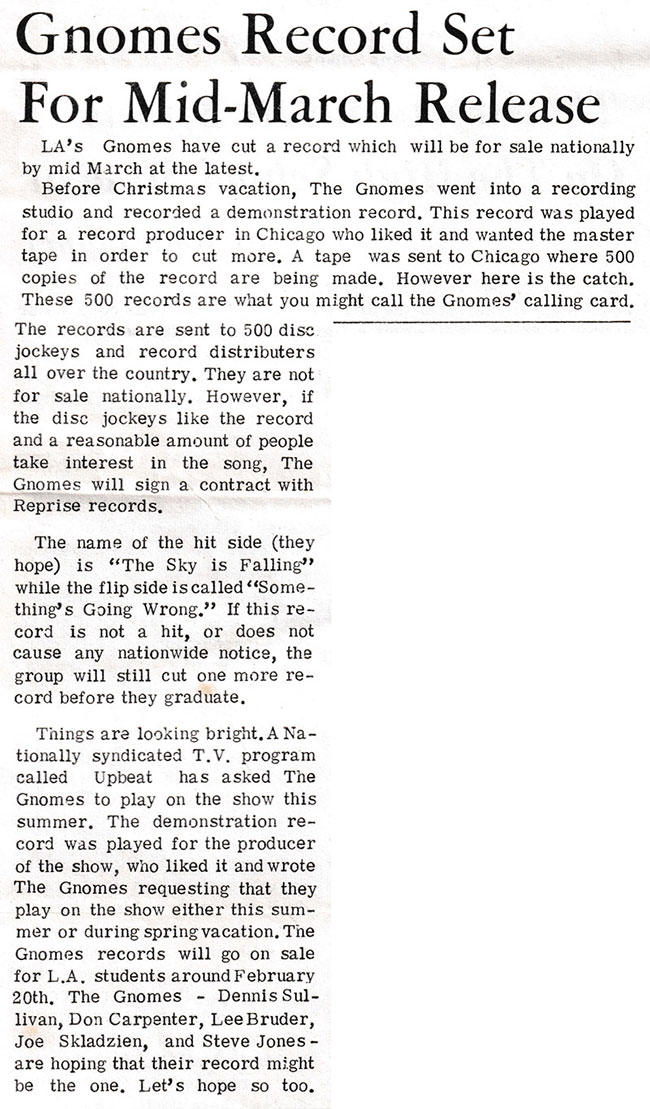
As Nightrocker helmed the wheel, navigating the narrow road and sharp turns as we climbed closer to Lee’s home, I prepared the visuals: the Lawrence Academy campus newspaper clipping featuring the Gnomes and their forthcoming record, my TeenBeat Mayhem book, a CD of both Gnomes songs, and an outline of queries to present. Lee already answered some basic questions during our phone call which allowed me to frame and fine-tune specific cues that might evoke buried memories. He warned me then that his memories of the LA era were fleeting.
• • •
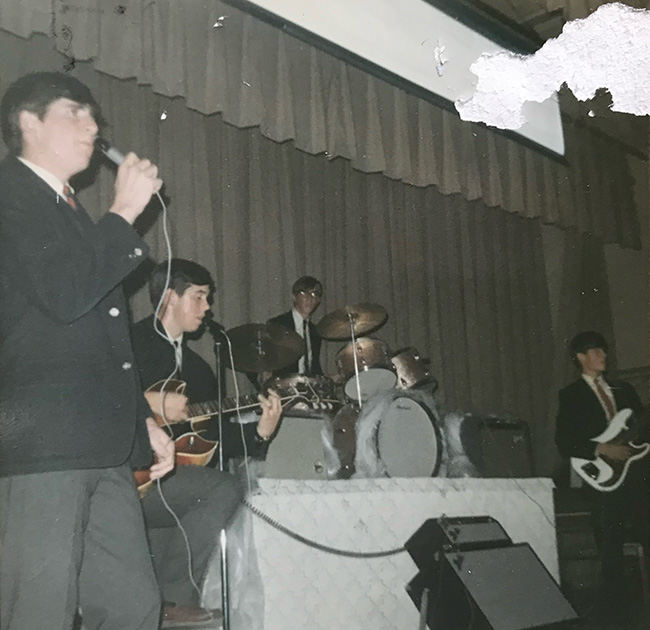
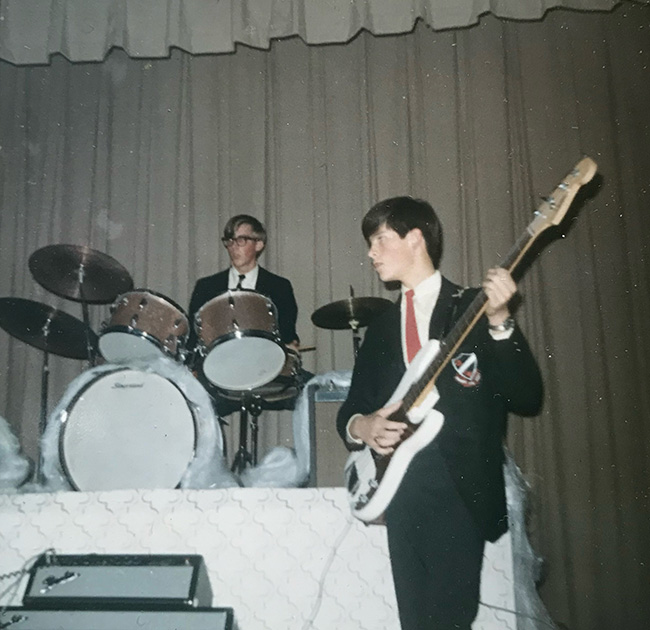
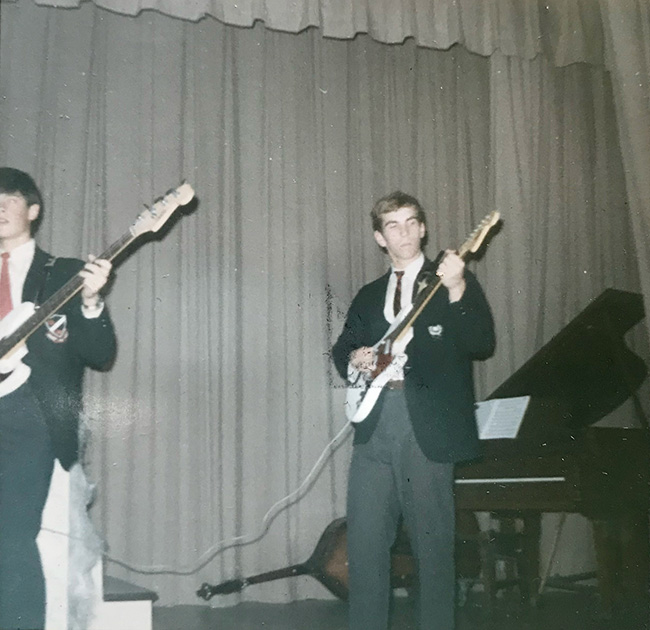
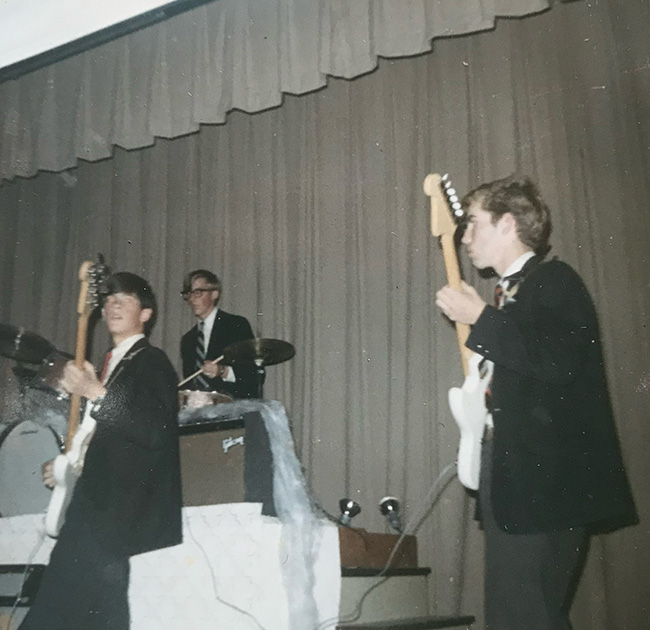
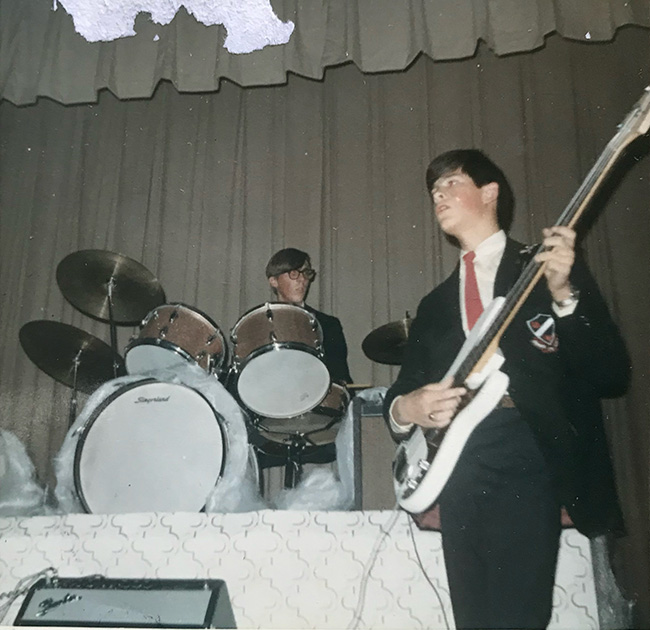
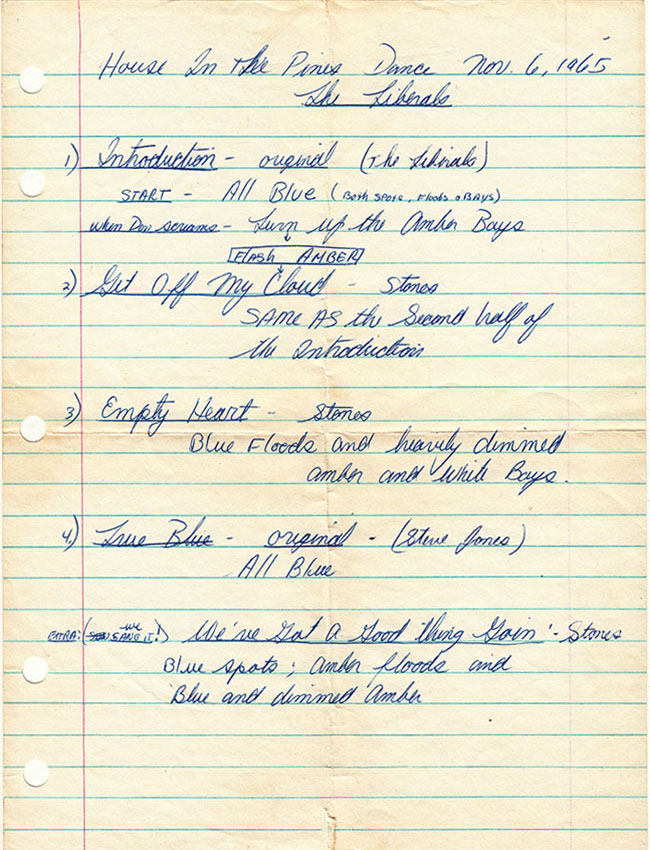
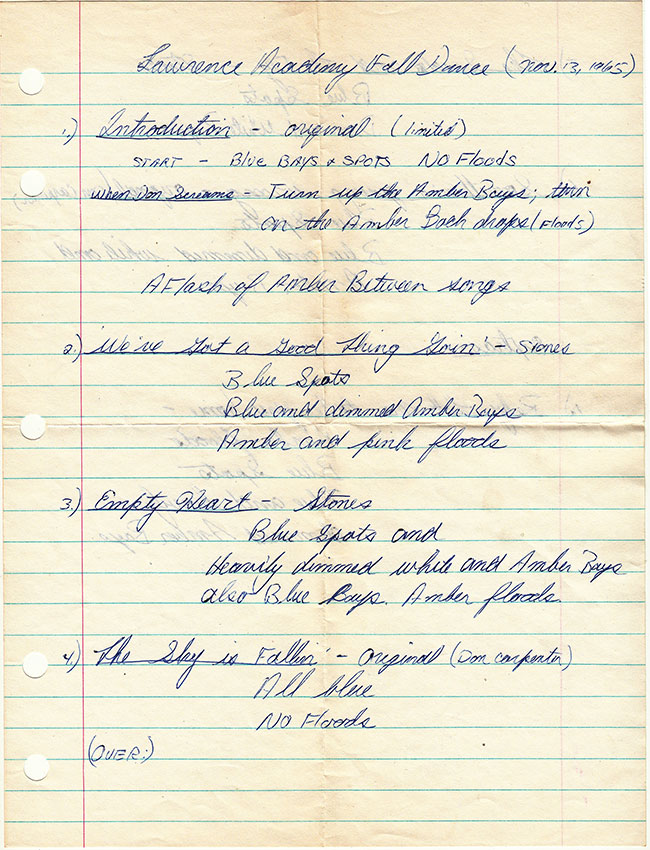
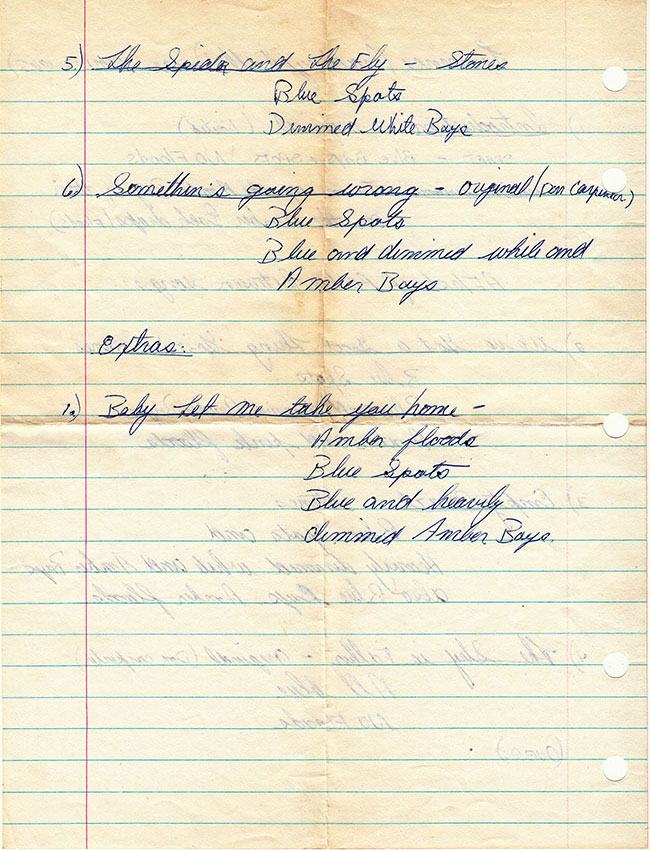
Lee Bruder came out his front door to greet us as we parked in the driveway. Tall and wiry, he welcomed us warmly and invited us inside. After showing us around, admiring the view from his large window overlooking the mountain range (a mirror image of the majestic Colorado Rockies) and introducing his wife Rita, we all sat down amidst finger foods of various kinds with choice of a beverage. “Here’s my scrapbook,” said Lee, handing it to Nightrocker, who had just set up his scanner. He got busy right away. “Wow, check out these cool pix…a Gnomes setlist too!” Nightrocker exclaimed. I took a gaze at the array of photos and two setlists affixed to one page. Both set lists archived performances from November, 1965. Lee replied, “We were pretty big on the Rolling Stones, Animals, all those kinds of groups.”
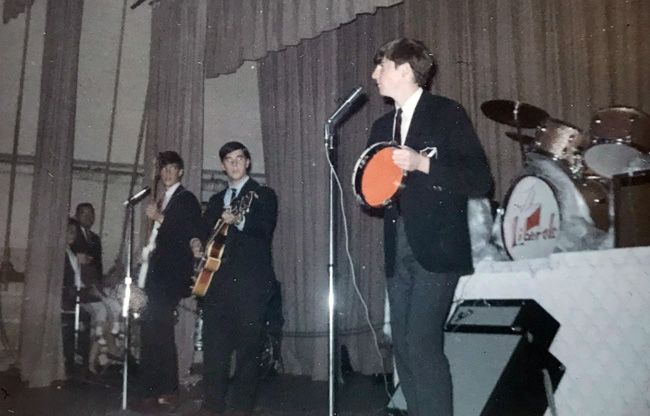
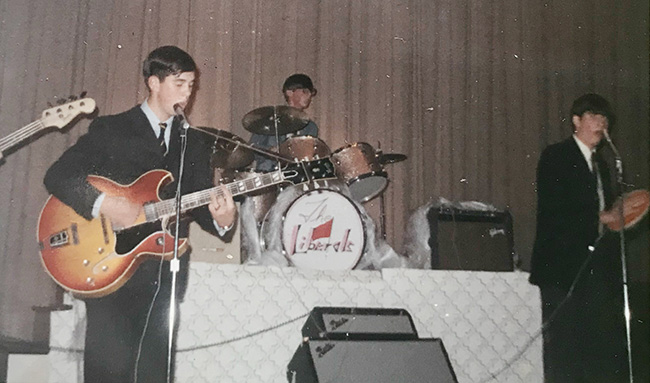
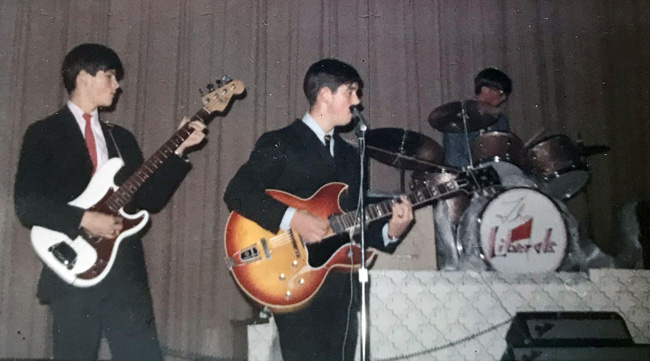
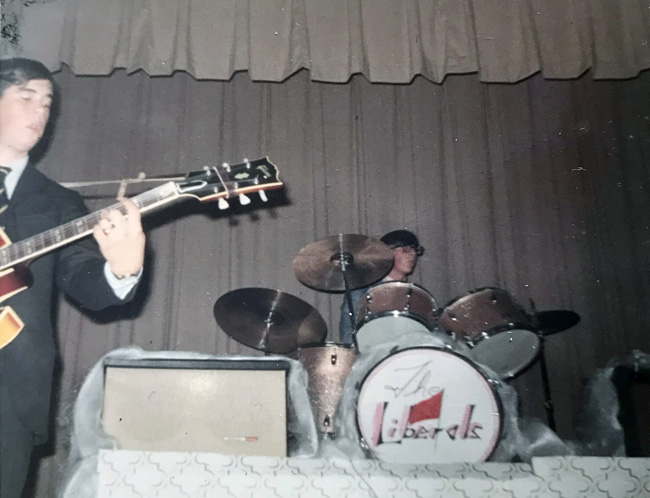
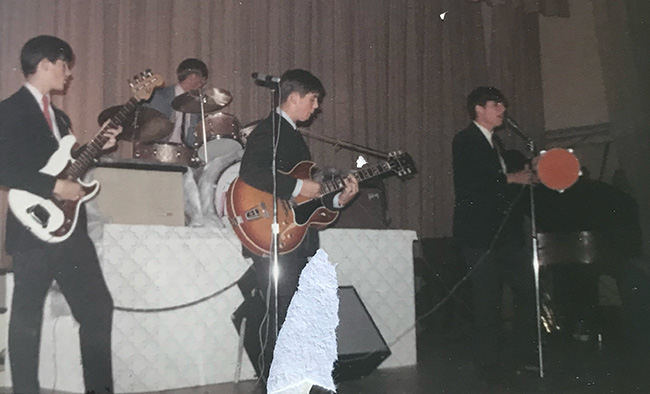
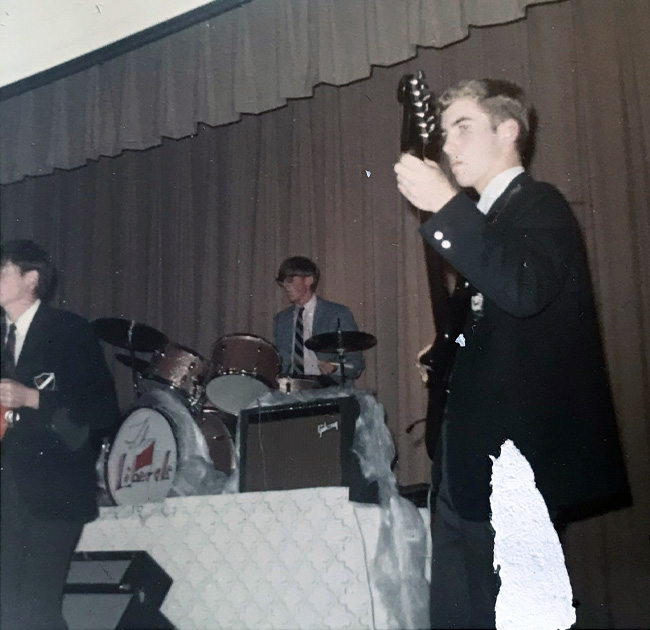
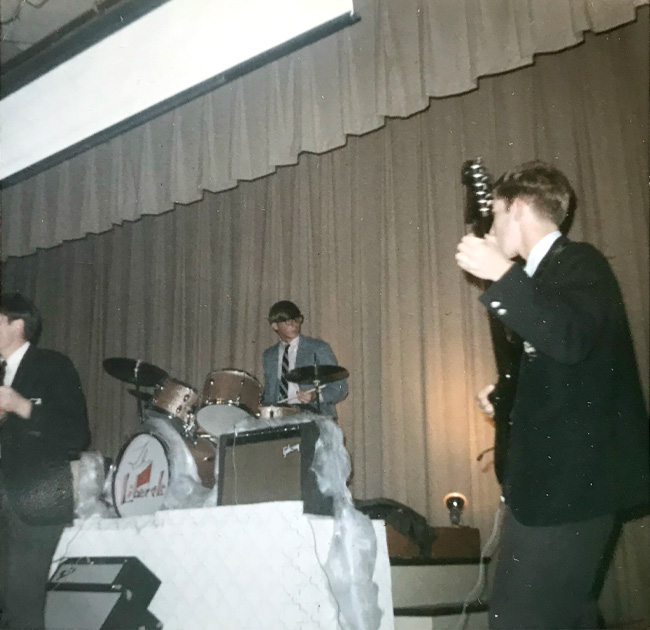
Lee placed his copy of the acetate with both songs on the table. However, the name of the group written on the labels was not the Gnomes: “Our group name from the start was the Liberals, as you can see by the logo on my bass drum in some of the photos. I cannot remember why we changed our name. On my copy of the acetate disc we got after recording our two originals, I wrote “Orphans Of Time.” Maybe I was trying to think of another name to replace the Liberals, so I probably wrote that as a possibility. But we never considered it.”
Before we dug deeper, I steered Lee into retelling how he got started playing the drums and the circumstances leading to his enrollment at the Groton, Massachusetts prep school. He began, “I was born in Ridgewood, New Jersey. I started bangin’ on pots and pans at a young age; that propelled me into playing the drums. I had a kid’s drum set my parents bought for me. They set it up in our living room. It must’ve sounded better than having me bangin’ on pots and pans all the time! Didn’t know it back then, but I had what is now diagnosed as ADHD; this probably explains my parents’ decision to send me to boarding schools instead of a public school as I got as little older. I attended Cardigan Mountain School in Canaan, New Hampshire during my junior high grades. Extra curricular activity for me was playing in the school band.”
• • •
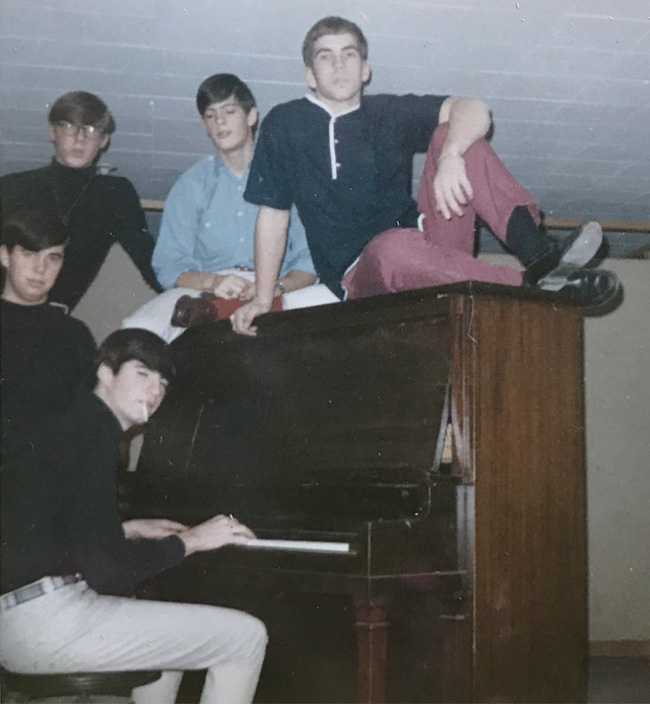
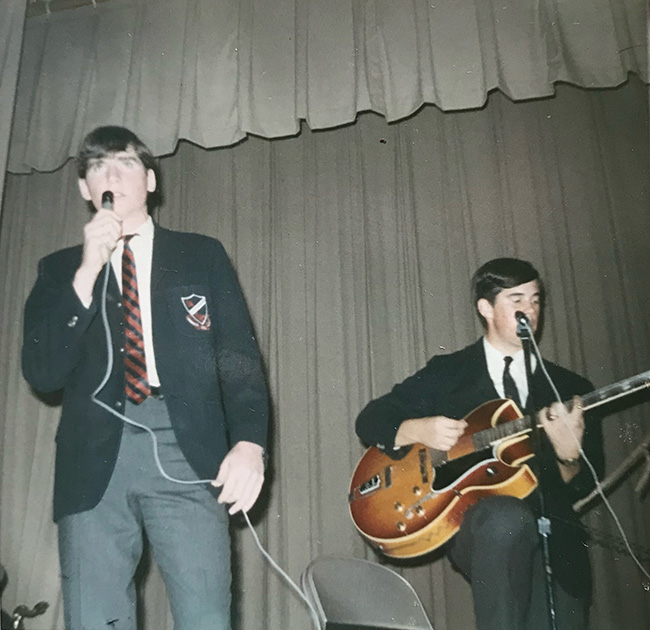
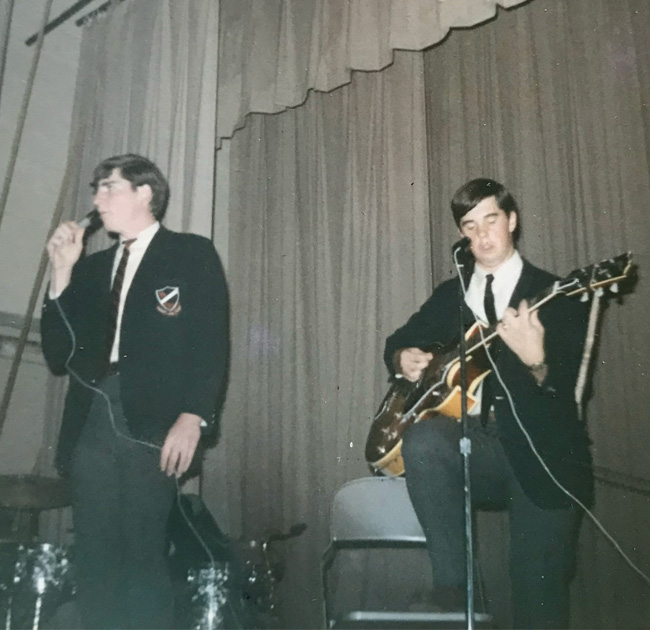
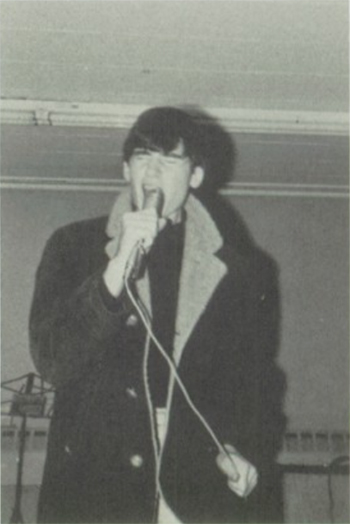
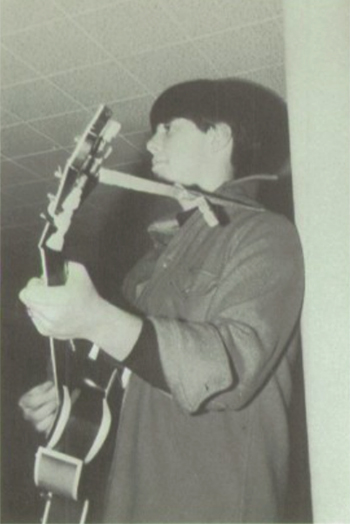
9th grade in the U.S. marks a student’s entry into high school. For Lee, that meant enrolling in the all male college preparatory school, Lawrence Academy. He related a few fragmented memories from those times, but kept reminding us, “I wish I could remember more details.” I offered up queries; most were met with the aforementioned response. However, he did tell us that he eventually met fellow classmates Don Carpenter and Dennis Sullivan. Those two were looking to form a rock & roll group. They sought out Lee when they heard that he played drums. Although Lee couldn’t pin an exact time frame, he suggested late 1964, early 1965: “We hit it off right away. There were no other rock & roll groups on campus. Just us. Once we got Joe and Steve into the band, we focused on rehearsing whenever possible. Don on lead vocals and keyboards, Dennis on rhythm guitar, Steve on lead, and Joe on bass. I do remember our practice spot — Room 107 on campus. That’s where those posed group shots were taken. We’d be playing and people would come in and check us out. The Liberals, in Room 107!” Lee then told us about the day a well-known professional musician had been speaking on campus. “David Amran entered the room as we were practicing. He carried his french horn. We stopped mid-song and David asked if he could jam with us. Wow! David Amran wants to jam with our group! To this day I cannot remember what songs we played, but David meshed perfectly with our rockin’ and rollin’. A definite highlight for me in my brief musical career…”
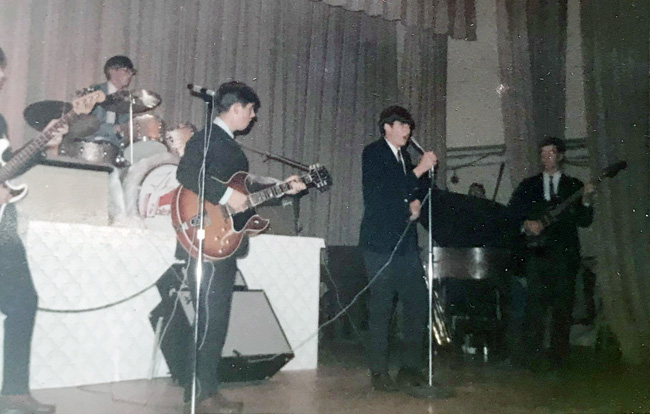
Attending an all-male school meant social interactions with girls could only be had on campus through formal mixers. For the Liberals, mixers provided opportunities to perform on stage. Nightrocker asked Lee about the two handwritten set lists, from 1965 with lighting cues for each song. The second set list took place at an all-girls school. The dance was billed as House Of The Pines, located nearby to LA. Lee: “I don’t know if that school is even around anymore. Or even remember the name of it. But we got the gig, it was great, the girls nearly mobbed us just like the Beatles. The first (November 6th), was our annual Lawrence Academy fall dance. We played the Stones, Animals, the wilder Top 40 stuff. Don could really belt it out, a great front man on stage like Mick Jagger. And we always played our original songs in our sets..” One original song, “True Blue,” was written by Steve Jones. Lee could only recall that it had to be a pretty good tune, since they played it live along with “Something’s Going Wrong” and “The Sky Is Falling.” As the set lists seemed pretty short, I offered up the possibility that a DJ could also have been there to spin 45s since there was no other group on the bill.
Then, the BIG question is asked: How did making the record come to pass? Again, Lee apologized for not being able to pin down specifics, but thanks to the LA campus newspaper article from early 1966, he offered his best recollection: “A classmate, can’t remember his name, he kept telling us we needed to make a record and that he knew somebody in Boston that had a connection to a recording studio. We were like ‘Yeah, let’s do it’ and set up a session one weekend. I don’t remember too much about the day of our recording session, other than the engineer positioned me behind those sound baffles. We’d been playing those two songs for several months so once the engineer got the levels set, we only needed a couple of takes at the most. We played everything live. It went by pretty quickly. When we were finished, the engineer cut those lacquer coated metal discs from the tape, we each got one.”
I then reminded Lee about our initial phone conversation, noting the decades of confusion regarding the source and location for the Gnomes 45, on a Chicago-based record label operated by Vic Faraci, and that most collectors assumed the group was from Chicago, or a nearby location. There was even another group called the Gnomes, discovered as being active at the same time in the Chicago area, but members of that group denied ever making any recordings. Thanks to the LA campus newspaper article, Lee was able to offer: “Now I remember…yeah…we managed to get the tape of our session to somebody out in Chicago, I’d forgotten that.” Dennis Sullivan, according to his obituary, had relatives in the Chicago area, and that he relocated there (shortly after graduating from LA). Lee: “The record deal had to have been done through Dennis’ family connections. Maybe the people in Chicago did not want us to use the Liberals, or maybe we already decided to change our name for the record. Still not sure how or why the Gnomes was chosen, but we all agreed on it.”
• • •
The LA newspaper article was published in early February 1966, following the students’ return to campus after their annual winter break. The uncredited writer touted that the Gnomes record would be available on campus around the 20th, and that 500 copies were already being distributed for promotional purposes. The writer went on to note that if the songs started to get airplay, their record would be picked up by Reprise records. If not, the group would still make another recording before graduation. To top it all off, the Gnomes were invited to appear on ‘Upbeat,’ the syndicated teenage dance show out of Cleveland, Ohio. Things were really looking up! I told Lee the guys must have been totally psyched for 1966 when they returned from winter break.
“Yeah…for about five minutes…” Lee responded, with a chuckled lament. “By the time that article appeared in the campus newspaper, I was gone.”
What??
The Sky Is Falling…
Something’s Going Wrong…
Quite apropos, as both song titles epitomized the situation at that point in time for the group, including Lee: “A buddy of mine asked if I could hide some booze for him. A couple beers. For some stupid reason I agreed to hide them temporarily. Alcohol was not permitted on campus. No exceptions. Well, he never came back to get his beer and I forgot about his stuff in my closet. Then everyone went home for winter break a week or so before Christmas. The LA housekeeping folks evidently rifled through my closet one day and found the booze. The day I returned to campus, I was summoned to report to the administration office. They told me I was being expelled from LA for violating their no alcohol policy. Didn’t matter if the booze wasn’t mine. I was immediately sent packing. I had to finish the last semester of my senior year in a public school.”
With Lee no longer allowed anywhere on campus, it also meant no drummer for the Gnomes. As we were only able to go by Lee’s personal recollections, it is not known if the rest of the guys tried to keep things going or if they just packed it in. Most likely the latter, as both Don and Dennis would graduate in May. Joe also left LA in 1966 according to the alumni office, a couple of years before his class graduation. Lee never saw or heard from any of the guys again following his expulsion. This abrupt ending reminded me to mention the autographed Gnomes 45 with a personal message from Carp. Lee reflected: “That must’ve been my copy of the record, since Don’s inscription mentions me not being able to graduate from Lawrence, and that I’d finally get laid since I’d have to go to a public school for the rest of my senior year. I lost the 45 at some point in time.”
Lee eventually graduated from high school and went on to enroll at Drew University in Madison, New Jersey. He joined a rock group as their drummer while in college: “We opened for the Who,” Lee boasted, showing us a few autographed photos. But playing drums did not last too long for Lee as he got heavily involved with promoting and booking rock & roll shows on and off campus. His promotion experiences eventually propelled Lee into the legal and finance arenas where he made his living prior to retiring. He and Rita currently enjoy a relaxed lifestyle living in the New Hampshire mountains. I could get used to living nearby them, enjoying the fresh mountain air, away from city hustle ‘n’ bustle…especially so if MY neighbor was involved with making one of the coolest two-sided garage discs from 1966. Lee remains amazed and humbled that people worldwide know of the Gnomes tunes, yet nothing makes him more prouder than this: “My grandkids had no idea I played in a rock & roll group and that we made a record. I never really mentioned it until you contacted me out of the blue. I recently played the songs for them. Now, they think I am SO cool!”
Yeah, Lee Bruder, you certainly are!
Now, both Gnomes tracks are available on the Gear Fab compilation CD, TeenBeat Mayhem presents: “Slipped Through The Cracks.”
Thanks to Lee Bruder and his wife Rita, both the most gracious of hosts for inviting us in that afternoon and for putting up with our record geek fanaticism!
 |
 |
 |
 |
 |
 |
 |
 |
 |
 |
 |
 |
 |
 |
 |
 |
 |
 |
 |
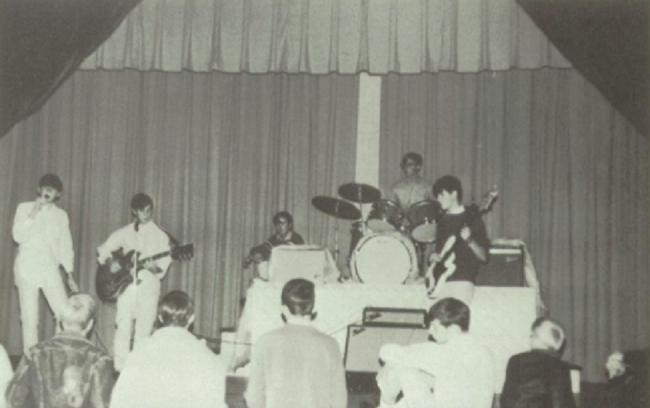 |
| Above and below: Gnomes photos from the Lawrence Academy 1966 yearbook! |
 |
 |
 |
 |
 |
 |
THE GNOMES
The Sky Is Falling / Something's Going Wrong
Afton Recordss (1702 • FT #3 / FT #4)
February 1966
 |  |
 | |
 |  |